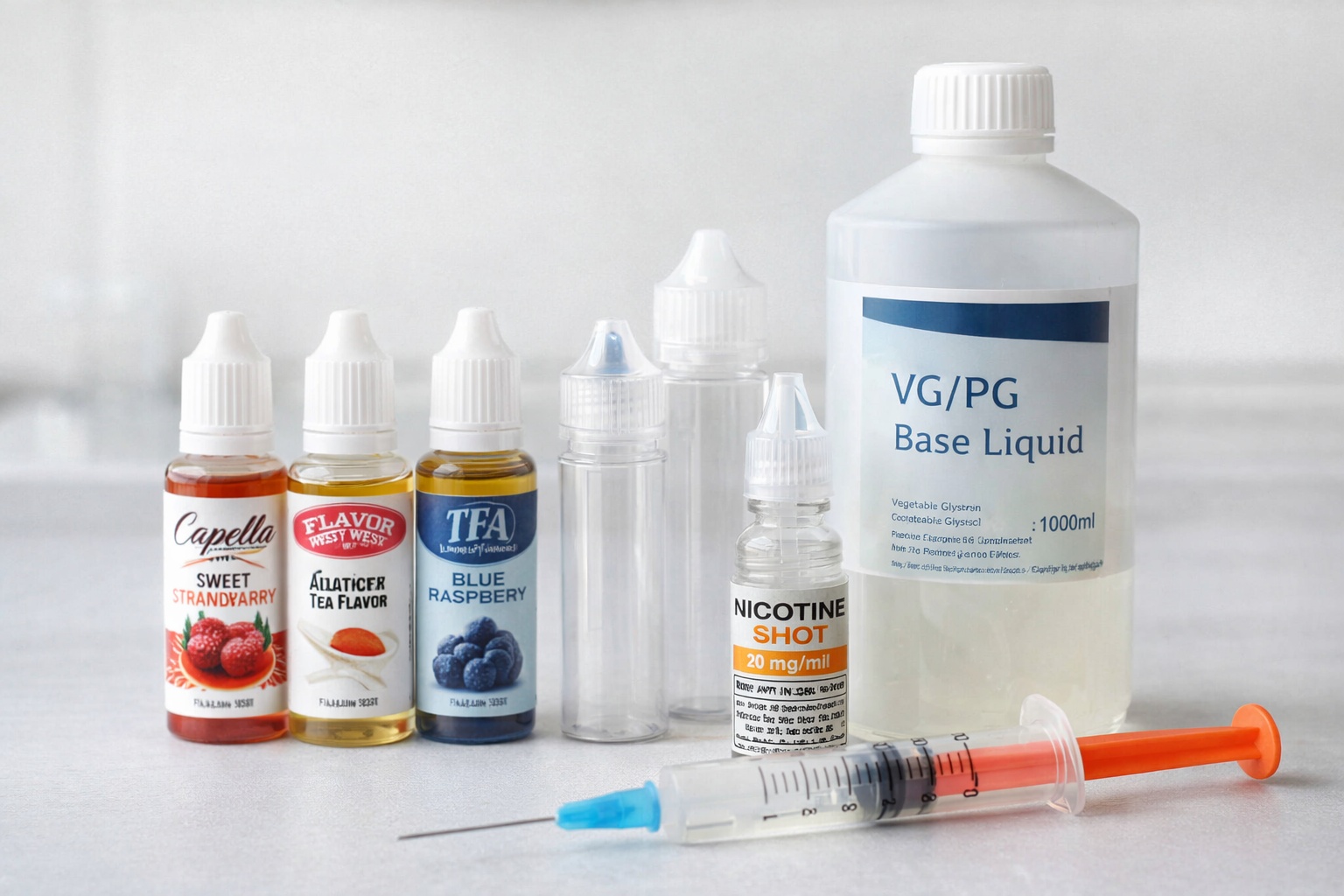
Mixing your own e-liquid (DIY e-liquid) is popular among vapers who want more control over flavour, nicotine strength, and VG/PG ratios. Instead of relying only on pre-mixed products, DIY lets you tailor every part of your vape and often reduce long-term cost per millilitre.
Whether you are new to mixing or you want a more consistent process, this guide covers the essentials from choosing ingredients to avoiding common mistakes. By the end, you will understand how to create safe, consistent, and great-tasting e-liquid.
What is DIY e-liquid?
DIY e-liquid is the process of creating your own vape juice by combining flavour with a base liquid and, optionally, nicotine. Unlike ready-to-vape formats such as shortfills, DIY mixing gives you full control over the final result.
Most mixers choose between three main formats:
- Flavour concentrates (single flavours used to build your own recipes)
- One shots (pre-balanced flavour recipes)
- Longfills (oversized bottles with concentrate and space to add base and nicotine)
Why more vapers are switching to DIY
DIY is not only about saving money. For many vapers it becomes the preferred approach because it offers freedom, consistency, and customisation that pre-mixed e-liquid cannot match.
- Complete flavour control: adjust sweetness, cooling, intensity, and complexity.
- Flexible nicotine strength: mix to your preference instead of fixed strengths.
- Better long-term value: components often reduce cost per ml over time.
- Consistency: once you find a mix you love, you can reproduce it reliably.
What you need to start mixing
DIY can sound technical, but the basics are straightforward. Here is what you need to get started.
1) Base liquid
Your base makes up most of your finished e-liquid and strongly affects vapour production, throat hit, and device compatibility. Explore options here: Base liquid.
2) Flavour (concentrates, one shots, or longfills)
You can mix using single flavour concentrates, convenient one shots, or beginner-friendly longfills. Each format supports DIY, but the workflow differs slightly.
3) Nicotine shots (optional)
Nicotine shots allow you to customise final strength. If you prefer nicotine-free vaping, you can skip this step entirely and mix with base liquid only.
4) Bottles
Clean bottles help you measure accurately and store mixes properly. See options here: Bottles.
5) Measuring tools
Precision matters for consistency. Measuring tools make mixing easier and reduce waste. Browse tools here: Measuring tools.
VG vs PG explained
Understanding VG and PG is essential because the ratio affects flavour delivery, vapour production, and how well a liquid wicks in your coil.
VG (Vegetable Glycerin)
- Thicker consistency
- Smoother inhale
- Denser vapour
- Slight natural sweetness
PG (Propylene Glycol)
- Thinner consistency
- Stronger throat hit
- Carries flavour more efficiently
- Often preferred for MTL and many pod systems
Common VG/PG ratios
- 70/30 VG/PG: often used for sub-ohm tanks and higher vapour production.
- 50/50 VG/PG: balanced option for many pod systems and MTL setups.
Longfills vs one shots vs flavour concentrates
A common beginner question is which format to choose. Here is a practical breakdown.
Longfills
Longfills are supplied in oversized bottles with concentrate and space for base liquid and optional nicotine. They are popular because mixing is simple and requires fewer steps. Browse: Longfills.
One shots
One shots are pre-balanced recipes designed to be mixed as a single flavour blend. They are a strong choice for consistent results and easy mixing. Browse: One shots.
Flavour concentrates
Concentrates are single flavours intended for building custom recipes. They provide maximum creative control and are ideal for advanced mixers. Browse: Flavour concentrates.
Step-by-step: how to mix your first e-liquid
Use this process to get reliable results, whether you are mixing a longfill, one shot, or concentrate recipe.
Step 1: Prepare your workspace
Mix on a clean, stable surface. Keep bottles upright and have paper towels ready. If you are using nicotine, keep it away from children and pets.
Step 2: Add flavour
Add your flavour concentrate (or one shot) according to the recommended percentage or the instructions for that product format. If you are using a longfill, the flavour is already in the bottle.
Step 3: Add nicotine (optional)
If you use nicotine shots, add them before topping up with base liquid. This makes mixing easier and helps distribute nicotine evenly.
Step 4: Fill with base liquid
Top up with base liquid to your target volume. If you are mixing in a longfill bottle, fill to the bottle’s intended final volume.
Step 5: Shake thoroughly
Close the bottle tightly and shake well for 30–60 seconds. Consistent shaking improves flavour distribution and helps the liquid settle faster.
Step 6: Label your bottle
Write down the date, flavour, ratio, and nicotine strength. Labelling is one of the simplest ways to improve your DIY results over time.
Nicotine strength basics (mg/ml)
Nicotine strength is measured in mg/ml. The final strength depends on how much nicotine you add and the total final volume. In general, adding nicotine shots increases mg/ml, while adding more base liquid lowers the final concentration.
If you want more flexibility, consider mixing small test batches first so you can confirm the nicotine level and flavour intensity before producing a larger bottle.
What is steeping (and does it matter)?
Steeping means letting your e-liquid rest so flavours can blend and mature. Some mixes improve noticeably with time, while others are ready soon after mixing.
- Often benefits from steeping: desserts, custards, creams, bakeries.
- Usually ready sooner: fruits, cooling blends, menthol-style profiles.
Store bottles in a cool, dark place and shake occasionally. If a mix tastes sharp or unbalanced on day one, a short rest can help.
Common DIY mistakes to avoid
- Mixing without measuring: small differences in percentage can change the flavour dramatically.
- Using too much flavour: higher percentage can reduce clarity and taste “muddy”.
- Skipping labels: it becomes hard to replicate a good batch or correct a bad one.
- Rushing steep time: some profiles need time to become smoother and more cohesive.
Advanced tips for better results
- Make small test batches before committing to large bottles.
- Change only one variable at a time (ratio, percentage, or nicotine level).
- Keep a simple recipe log so you can repeat wins and avoid mistakes.
Safety best practices
- Store nicotine securely and out of reach of children and pets.
- Wear gloves when handling nicotine and clean spills immediately.
- Use dedicated bottles and tools for mixing.
- Label everything clearly, including nicotine strength.
Frequently asked questions
Is mixing e-liquid difficult?
No. Longfills and one shots make the process very simple, and most beginners become comfortable after a few batches.
Is DIY cheaper than buying ready-made e-liquid?
For many regular vapers, DIY reduces cost per ml over time, especially once you have bottles and measuring tools.
How long does e-liquid last?
Stored in a cool, dark place, most mixes remain usable for months. Flavour profiles can change slowly over time, so it is best to label the mix date.
Can I start with longfills as a beginner?
Yes. Longfills are one of the easiest ways to start DIY because they involve fewer measuring steps and provide consistent results.
Start mixing: ingredients and categories
If you want to start mixing today, explore the categories below and build a setup that matches your preferences: