
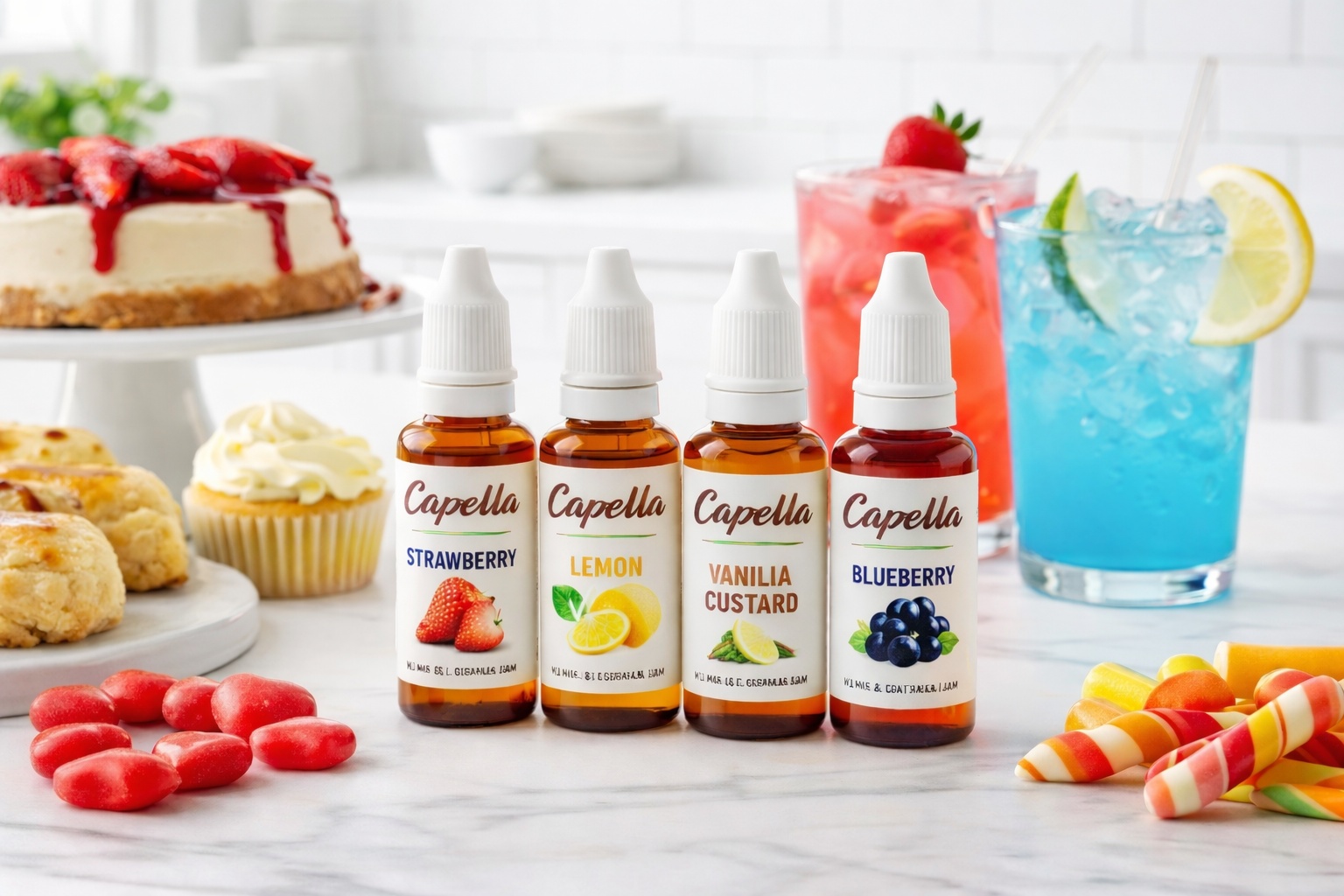
Flavour concentrates for food and drinks are concentrated flavourings that need to be measured into a suitable recipe. Choosing one involves more than selecting a flavour name: check the exact product’s intended use, ingredients, solubility and instructions before adding it to anything you eat or drink.
This guide explains how to assess a food flavouring, run a small recipe test and record the result. It does not provide a single dosage for every concentrate.
Check the product before choosing a recipe
- Intended application: confirm that the manufacturer identifies the exact flavouring as suitable for your food or drink.
- Ingredients and dietary requirements: read the complete declaration, including carriers, sweeteners and any allergen information.
- Solubility: check whether the formulation is water-soluble or oil-soluble rather than judging by the flavour name.
- Use level: look for guidance for the application you are making, such as a beverage or a baked product.
- Product identity: match the formulation, version and batch where applicable. Similar names do not establish identical ingredients.
If the information is incomplete, ask for the relevant product specification before using it in food. A concentrate being nicotine-free does not, by itself, establish suitability for cooking.
Water-soluble and oil-soluble flavourings
Capella describes separate water-soluble and oil-soluble ranges. Its water-soluble range predominantly uses propylene glycol and/or ethyl alcohol as carriers, while its oil-soluble range uses medium-chain triglycerides (MCT oil). This distinction matters when selecting an ingredient for a water-based drink or a fat-based recipe.
Do not assume that every product from one brand has the same carrier. Check the specification for the particular flavouring, and do not treat a general brand description as its full ingredient declaration.
Examples of documented culinary applications
Capella’s usage information describes applications in frostings, cakes, cookies, confectionery, coffee, tea and carbonated drinks. These are examples of applications within its range; the formulation and instructions for your chosen product still need checking.
A more specific example is Flavor West Pineapple Peach. The manufacturer identifies it as water-soluble, lists natural and artificial flavouring, propylene glycol and ethanol, and describes use in beverages, baking products and candy. That information applies to this named product rather than every pineapple, peach or Flavor West concentrate.
How much flavour concentrate should you add?
Use the manufacturer’s guidance for the exact food application. Strength varies between flavourings, and a percentage intended for another use is not a food recipe recommendation. There is no universal percentage that this guide can recommend for drinks, baking or sweets.
Capella recommends learning how its flavours perform through small batches and gradual additions. Follow any product-specific instructions or limits first. Record the quantity rather than relying on memory.
Understand what a percentage means
Check whether the instruction is by weight or by volume, and whether it refers to the finished recipe. These bases are not interchangeable.
Arithmetic example only, not a recommended dosage: if a validated recipe specifies 0.2% by weight in a 500g finished batch, the flavouring quantity is 500 × 0.002 = 1g. The other ingredients together total 499g. Do not convert that 1g to millilitres without the product’s density.
A practical small-batch testing method
- Choose one recipe and a flavouring documented for that application.
- Keep an unflavoured sample as a comparison.
- Prepare a small measured batch using the product’s instructions. Use clean equipment suitable for food preparation.
- Record the flavouring quantity, recipe weight or volume, and preparation method.
- Assess the prepared food or drink at its intended serving temperature. Do not taste the undiluted concentrate.
- Change one variable at a time in the next test so that you can identify what affected the result.
For a baked recipe, test the finished baked product before scaling up. Suitability for baking does not establish identical results at every temperature or cooking time. Follow application-specific guidance instead of assuming universal heat stability.
Keep flavour and sweetness separate
A flavour name such as candy, vanilla or caramel does not tell you whether sweetener is present. Capella states that its flavours are unsweetened apart from its Stevia range and flavour enhancers. Check the individual declaration, particularly for products labelled sweetener or enhancer; do not apply that statement to other manufacturers.
Storage and recipe records
Follow the bottle’s storage instructions and date information. For Pineapple Peach, Flavor West specifies a dry location out of direct sunlight at approximately 20–25°C. Other formulations may have different requirements. Do not assume a multi-year shelf life for every flavouring.
Keep the product name, batch details and original label information with your recipe notes. Close the bottle after measuring and keep it away from children. A food flavouring remains a concentrated ingredient rather than a ready-to-drink product.
Frequently asked questions
Can I replace vanilla extract with the same amount of a concentrate?
Do not assume a one-to-one substitution. Compare the two products’ intended uses and instructions, then test the adjusted recipe in a small batch.
Does water-soluble mean suitable for any drink?
No. Solubility describes one property of the formulation. Ingredients, intended application and use instructions must also match the drink you are making.
Can I use the same percentage for a cake and a beverage?
Only if the specific product guidance supports both applications at that level. The recipe and preparation method differ, so test them separately.
What information should I request if the label is unclear?
Ask for the exact product specification, complete ingredient and allergen information, application guidance and relevant batch documentation. Keep the product name and batch number available when requesting clarification.
Manufacturer references
- Capella: product ranges and carriers
- Capella: culinary applications and testing guidance
- Capella: sweetness and usage questions
- Flavor West: Pineapple Peach specification and storage
For questions about an item supplied by FC, contact us with its name and batch details.